|

flexible sigmoidoscopy
A Flexible Sigmoidoscopy enables the physician to look at this inside of the large intestine from the rectum through the last part of the
colon, called the sigmoid colon. Physicians may use this procedure
to find the cause of diarrhea, abdominal pain, or constipation.
They also use sigmoidoscopy to look for early signs of cancer
in the colon and rectum. With sigmoidoscopy, the physician can
see bleeding, inflammation, bnormal growths, and ulcers. For
the procedure, you will lie on your left side on the examining table.
The physician will insert a short, flexible, lighted tube into your
rectum and slowly guide it into your colon. The tube is called
a sigmoidoscope. The scope transmits an image of the inside of
the rectum and colon, so the physician can carefully examine
the lining of these organs. The scope also blows air into these
organs, which inflates them and helps the physician see better.
If anything unusual is in your rectum or colon, like a polyp or
Inflamed tissue, the physician can remove a piece of it using instruments inserted into the scope. The physician will send
that piece of tissue (biopsy) to the lab for testing.
Bleeding and puncture of the colon are possible complications
of sigmoidoscopy. However, such complications are uncommon.
A sigmoidoscopy takes about 10 minutes. During the procedure,
you might feel pressure and slight cramping in your lower abdomen.
You will feel better afterwards when the air leaves your colon.
Preparation
The colon and rectum must be completely empty for sigmoidocopy
to be thorough and safe, so the physician will probably tell you to drink
only clear liquids for 12 hours beforehand. A liquid diet means fat free
bouillon or broth, Jell-O, strained fruit juice, water, plain coffee, plain
tea, or diet soda. The night before or right before the procedure, you
may also be given an enema, which is a liquid solution that washes out
the intestines. Your physician will give you instructions to follow to
prepare for the procedure.
><
Colonoscopy Information for Newtown & Langhorne, PA
A Colonoscopy lets the physician look inside your entire large intestine,
from the lowest part, the rectum, all the way up through the colon to the lower end of the small intestine. The procedure is used to diagnose the
causes of unexplained changes in bowel habits. It is also used to look for
early signs of cancer in the colon and rectum. Colonoscopy enables the
physician to see inflamed tissue, abnormal growths, ulcers, bleeding and
muscle spasms.
For the procedure, you will lie on your left side on the examining table.
You will be given a sedative to keep you comfortable and to help you relax
during the exam. The physician will insert a long, flexible, lighted tube into
your rectum and slowly guide it into your colon. The tube is called a
colonoscope. The scope transmits an image of the inside of the colon, so
the physician can carefully examine the lining of the colon. The scope bends
so the physician can move it around the curves of your colon. You may be
asked to change position occasionally to help the physician move the scope.
The scope blows air into your colon, which inflates the colon and helps the
physician see better.
If anything unusual is in your colon, like a polyp or inflamed tissue, the
physician can remove a piece of it using tiny instruments passed through
the scope. That tissue (biopsy) is then sent to a lab for testing. If there is
bleeding in the colon, the physician can pass a laser, heater probe, or electrical
probe, or inject special medicines, through the scope and use it to stop the bleeding.
Bleeding and puncture of the colon are possible complications of colonoscopy.
However, such complications are uncommon.
A colonoscopy generally takes less than 30 minutes. The sedation should keep
you from feeling much discomfort during the exam. You will need to remain at the
Endoscopy Center for 30 minutes to and hour until the sedative wears off.
Preparation
Your colon must be completely empty for the colonoscopy to be thorough and
safe. To prepare for the procedure you will have to follow a liquid diet for 1 day
beforehand. A liquid diet means bouillon or clear broth, Jell-O (not red or purple),
fruit juices, water, plain coffee, plain tea, or soda. You will need to take laxatives
the day before the procedure. Also, you must arrange for someone to take you home afterward. You will not be allowed to drive because of the sedatives.
Your physician will give you instructions to follow to prepare for the procedure.
><
upper endoscopy (EGD)
An Upper Endoscopy enables the physician to look inside the esophagus,
stomach and duodenum (first part of the small intestine). The procedure
might be used to discover the reason for swallowing difficulties, nausea,
vomiting, reflux, bleeding, indigestion, abdominal pain, or chest pain.
Upper Endoscopy is also called EGD, which stands for esophagogastroduodenoscopy.
For the procedure you will swallow a thin, flexible lighted tube called an
endoscope. Right before the procedure. You will receive a sedative to help
you relax during the exam. The endoscope transmits an image of the inside of the esophagus, stomach, and duodenum, so the physician can carefully
examine the lining of these organs. The scope also blows air into the stomach; this expands the folds of the tissue and makes it easier for the physician to
examine the stomach.
The physician can see abnormalities, like ulcers, through the endoscope that
don’t show up well on x-rays. The physician can also insert instruments into
the scope to remove samples of tissue (biopsy) for further tests.
Possible complications of an Upper Endoscopy include bleeding and puncture
of the stomach lining. However, such complications are rare. Most people will
probably have nothing more than a mild sore throat after the procedure.
The procedure takes less than 15 minutes. Because you will be sedated, you will
need to rest at the Endoscopy Center for about 30 minutes to an hour until the
medication wears off.
Preparation
Your stomach and duodenum must be empty for the procedure to be thorough
and safe, so you will not be able to eat or drink anything for at least 8 hours
beforehand. Also, you must arrange for someone to take you home. You will not be allowed to drive because of the sedatives. Your physician will give you instructions
to follow to prepare for the procedure.
><
Capsule Endoscopy
Capsule endoscopy is a procedure designed to help your physician see what
is happening inside parts of your gastrointestinal (GI) tract. The GI tract is
the tube which extends from the mouth to the anus in which the movement
of muscles digests food. During the procedure, a patient wallows a vitamin
-size pill with a camera inside. Transported smoothly and painlessly through
the GI tract by the body’s own natural peristalsis, the PillCam video capsule ransmits images of different parts of your body such as the small intestine
and the esophagus. Since the first Pillcam™ video capsule was approved by the FDA in 2001, more than 700,000 patients have safely swallowed one of the
Pillcam™ video capsules.
Capsule endoscopy is the least invasive and most direct way for doctor’s to
see the entire small intestine and esophagus. Hundreds of clinical studies
conducted by the world’s leading gastroenterologists have shown the value
of the Pillcam™ video capsules in helping diagnose or rule out disorders
of the GI tract.
Pillcam™ SB
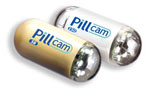 The Pillcam™ SB video capsule is designed specifically to help your doctor
see inside your small bowel (small intestine) to diagnose disorders such
as Crohn’s disease, Celiac disease, benign and cancerous tumors, ulcerative
colitis as well as other disorders. The small intestine is the part of the gastrointestinal tract that connects the stomach to the large intestine and
absorbs nutrients. The Pillcam™ SB video capsule is designed specifically to help your doctor
see inside your small bowel (small intestine) to diagnose disorders such
as Crohn’s disease, Celiac disease, benign and cancerous tumors, ulcerative
colitis as well as other disorders. The small intestine is the part of the gastrointestinal tract that connects the stomach to the large intestine and
absorbs nutrients.
Pillcam™ SB transmits images at a rate of two images per second for
approximately eight hours, resulting in more than 50,000 images.
><
Bravo Wireless pH Monitoring
Ambulatory pH monitoring provides information about the duration, pattern and symptom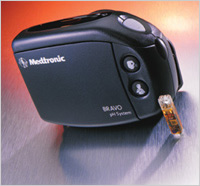 correlation of distal esophageal acid exposure from gastroesophageal reflux (GERD). This information is very useful in diagnosing GERD in patients with atypical symptoms (chronic cough, laryngitis, chest pain among others) and assessing response to medications in patients with known GERD. correlation of distal esophageal acid exposure from gastroesophageal reflux (GERD). This information is very useful in diagnosing GERD in patients with atypical symptoms (chronic cough, laryngitis, chest pain among others) and assessing response to medications in patients with known GERD.
With older traditional pH monitoring systems, a catheter is inserted through the patient's nose and into the esophagus. Wires connect the catheter to a portable device that records pH levels. This method was cumbersome, inconvenient and interfered with usual daily activities. The Given Imaging catheter-free monitoring system utilizes a small pH capsule (about the size of a gel cap) that is temporarily attached to the wall of the esophagus during an endoscopy. The capsule transmits pH data wirelessly via radio frequency telemetry to a pager-sized receiver worn by the patient.
Catheter-free pH monitoring provides significant benefits to patients:
- Allows patients to maintain regular diet and activities
- Better tolerated than catheter-based tests
- Eliminates social embarrassment that accompanies traditional pH testing with no visible indication that pH test is taking place
How It Helps Diagnose GERD
Ambulatory pH monitoring provides measures of the severity and frequency of acid reflux and allows correlation of reflux events with patient symptoms (both typical and atypical).
Catheter-free pH testing provides several diagnostic benefits:
- Extends pH data collection to 48 hours — a full 24 hours beyond the recording capability of conventional catheter systems
- Better reflects patients physiologic condition when patients maintain regular diet and activities
- Double the data: increasing the ability of documenting relationships between atypical symptoms and reflux events.
How the Bravo System Works
The test involves a miniature pH capsule, approximately the size of a gelcap that is attached to your esophagus. Throughout the test period, the Bravo capsule measures the pH in the esophagus and transmits this information to a pager-sized receiver worn on your belt or waistband just like a pager or mobile phone. You will be given a diary to write down the times when you have reflux symptoms (for example, coughing, heartburn, regurgitation), when eating or when lying down. After the test is completed, you return the diary and the Bravo Receiver to your doctor and the information is uploaded to a computer, which provides a comprehensive report so the physician can diagnosis your condition.
Frequently Asked Questions
What are the benefits of the Bravo System?
The Bravo pH system provides comfort and convenience. Data is recorded when the capsule and receiver are within 3 feet of each other. What this means is you can bathe and get a restful night’s sleep because you can place the receiver outside the shower or on your nightstand and the test will not be interrupted.
How long does the Bravo test take?
The capsule takes only moments to place in the esophagus. Then, the Bravo test lasts for 48-hours.
Will the Bravo test restrict my diet and activities?
The test is catheter-free and the receiver is small so you may eat normally and go about your daily routine without any restrictions.
What happens when the Bravo test is complete?
After the test period, you return the Bravo Receiver to the hospital. The test data is uploaded to a computer and analyzed by your doctor. Your physician will inform you of your results soon after the test.
What happens to the capsule after the test?
Several days after the test, the capsule naturally falls off the wall of the esophagus and passes through your digestive tract and is eliminated from the body.
Can I have an MRI (Magnetic Resonance Imaging) during the test?
Patients are restricted from undergoing an MRI study within 30 days of the Bravo procedure.
Will I feel the capsule during the test?
Some patients say they have a vague sensation that “something” is in their esophagus. Some patients say they feel the capsule when they eat or when food passes the capsule. Should you experience this, chewing food carefully and drinking liquids may minimize this sensation.
Is Bravo for everyone?
Unfortunately, it is not for everyone. Patients with pacemakers, implantable defibrillators or neurostimulators cannot use Bravo. Patients with a history of bleeding diatheses, strictures, severe esophagitis, varices and obstructions are not candidates for Bravo.
Bravo wireless pH monitoring is performed by our physicians at St. Mary Medical Center in Langhorne, PA.
><
|
